
How BonsenReuling moved from rigid file storage to intelligent information management with M-Files
BonsenReuling is an accounting and consulting firm with over 230 employees and eight offices in the eastern Netherlands. Founded in 1923, the firm has grown into a household name in the region. As a trusted advisor to entrepreneurs from sole traders to controlling companies.
BonsenReuling's pay-off: Sharp on all points, is not a marketing slogan. It is a promise towards their clients. And that sharpness starts internally. In processes, systems and the way documents and files are managed. Because if you want to advise and serve your clients sharply, you have to be sharp yourself.
Content
Can you help me search?
When Maarten van der Veer took office as ICT manager at BonsenReuling in the summer of 2023, he found an IT environment that was technically a step behind. The office was still operating in an RDS environment. Employees first logged on to a central server before they could get to work. Working locally on a workstation, now the norm in modern organisations, was out of the question
Maarten, who previously worked for almost a decade at a large retailer in a fully integrated Microsoft Cloud working environment, immediately saw what needed to change first. The document management system. The on-premise DMS of the time, although already working with metadata, stayed close to a classic folder structure. Because of this set-up and because documents were provided with incorrect and/or inconsistent metadata, retrieval of documents and files was the problem.
Maarten says: “It was always quite a challenge to find documents back in the folder structure. Employees regularly sent support tickets to IT with: ‘I can't find a document, can you help me look for it?’ Then it turned out that a document was wrongly tagged or linked to the wrong customer. And then you could never find it again.”
Philosophy behind M-Files prevailed
The strategic ambition Maarten formulated internally for IT infrastructure modernisation was clear: fully to SaaS and the cloud, working locally on laptops, and information management that grows with the organisation. For this, the DMS had to be replaced first. BonsenReuling tackled the selection thoroughly. Seven systems and suppliers visited for interviews and demos. This eventually led to a shortlist of two. M-Files via GeONE was one of them.
Maarten: “Both were subjected to an extensive Proof of Concept. We didn't want a superficial demo, but a real test with data, configured metadata and set-up processes. We involved 20 key users from all disciplines of BonsenReuling. From assistant accountant to partner. We deliberately also involved the critical voices in the PoC phase. The people who asked out loud why all this was actually necessary. Because if you get those people on board, the rest will automatically follow.”
The rash ultimately gave the philosophy behind M-Files: use over store. So not where is the document, but what is the document. The metadata idea: documents as objects with properties instead of files in folders, turned out to be exactly what BonsenReuling needed.
Getting to where M-Files is today with GeONE
“The implementation emphatically did not become an IT project,” Maarten points out. “The key users determined the set-up, not the ICT department. That attitude sometimes led to discussions internally, but it is really the business that has to work with it. GeONE fitted in seamlessly with our approach.
The consultants took BonsenReuling by the hand: they explained the capabilities of M-Files, shared best practices from other accounting firms and fuelled discussions in the project group. GeONE did not make any decisions for us. They fed the dialogues and every choice was put back to the business. This is how we got together to where M-Files is today. That was very pleasant in the process.”
Pragmatic choice made the switch smaller
The trickiest part of the M-Files implementation was adoption. Moving from folders to metadata requires a different way of thinking. To ensure recognition, BonsenReuling rebuilt their familiar file structure in M-Files. A pragmatic choice that made the switch smaller. Everyone attended mandatory training in small groups of up to 15 people, with a test environment filled with real customer data and real documents.
This was followed by regular lunch sessions through Teams. Low-threshold, with free walk-in, for those who still had questions. “You can guess the result,” Maarten indicates with a smile. “The people with the strongest opinions at the time are now the people who are most comfortable working with M-Files.”
Scalability of M-Files put to the test
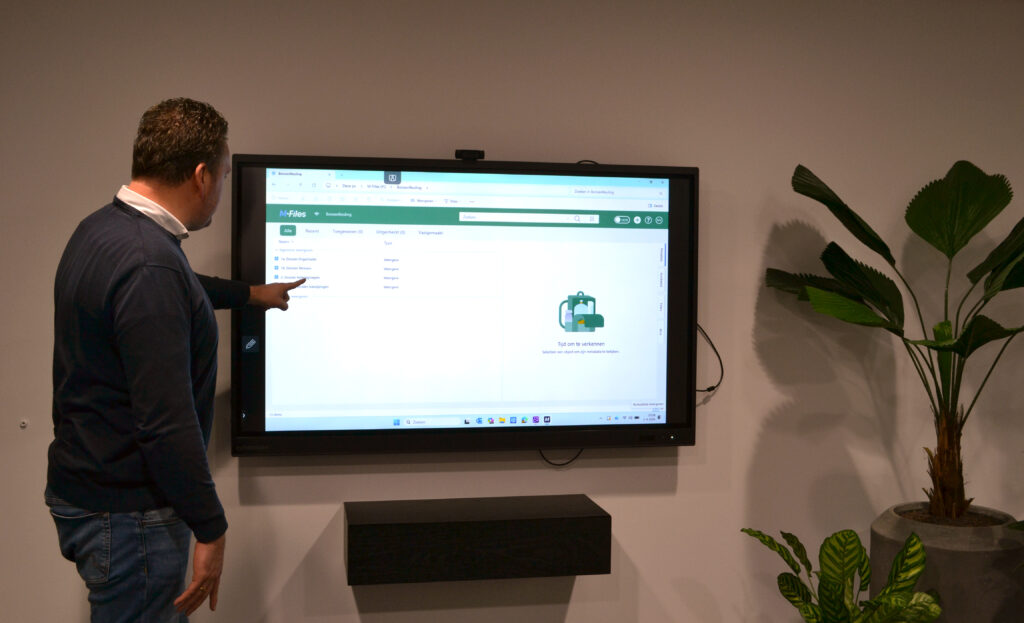
Network drives were introduced at M-Files on read-only put. Documents could still be viewed but no longer edited unless they were archived in M-Files. This was an elegant way of enforcing migration without feeling like coercion.
Maarten: “Shortly after going live, a litmus test for the scalability of M-Files followed. BonsenReuling merged with De Kok Accountants & Advisers. An organisation with three branches in Twente and 45 employees that was working with a different DMS and fileshares. The integration of all data in the BonsenReuling M-Files domain went almost flawlessly via GeONE's migration tooling. Meanwhile, the same tool is used for various bulk archiving. Documents are classified and shot into it at once.”
M-Files combined with Copilot will be a super powerful combination
BonsenReuling is closely following the strategic partnership between M-Files and Microsoft. The announcement that M-Files and Microsoft 365 are going to integrate more closely, including Copilot functionality, arouses real curiosity in Maarten. “If you set that up properly, you have a super powerful combination on your hands. Everyone can imagine how Copilot or Teams will soon integrate seamlessly with M-Files. I'm very curious to see what that will look like.”
The native AI capabilities of M-Files itself, Aino, is following BonsenReuling from a distance for now. The first version of Aino has been tested, but not yet put into production. The reason is pragmatic. Before AI can really do its job, the basics need to be in place. Access rights compartmentalised, metadata consistent, retention policy in place. Maarten: “The basics have to be right. Then you can move on very quickly and really harness the power of AI tools.”